Accountable Agents Framework: License Plates for AI
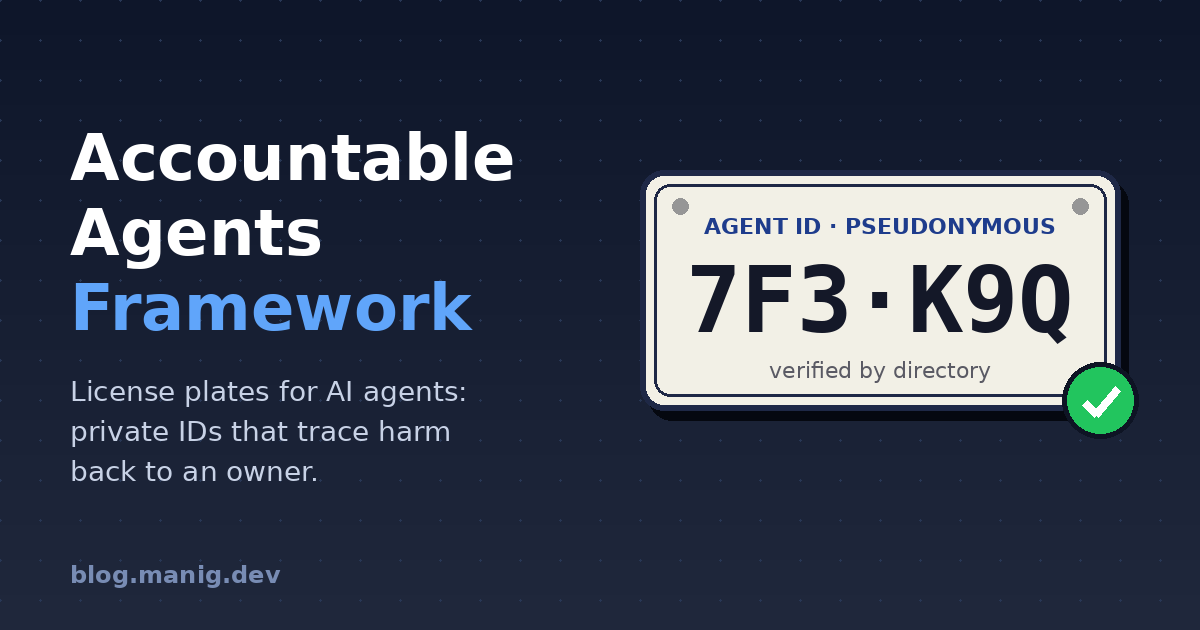
The Accountable Agents Framework is a new proposal that gives AI agents something like a license plate. It came out on November 24, 2026, from the Center for AI Safety and a long list of co-authors, including Dan Hendrycks, Gillian Hadfield, Bruce Schneier, Audrey Tang and Jonathan Zittrain. The short version: an agent carries an ID that says nothing about who owns it, until the agent does something bad. Then someone can find the owner.
I think this is one of the more useful agent papers of the year, mostly because it is boring in the right way.
What the Accountable Agents Framework actually does
Right now a website has two choices when an agent shows up. Block every bot, or let them in and hope. The paper calls this the "accountability gap": there is "no standardized way to identify agents or their principals online." A principal is just the person or company the agent works for.
AAF adds a third option. It has a few moving parts:
- Directories check who the principal is and issue IDs to their agents. The authors compare them to certificate authorities, the same outfits that make the padlock in your browser work.
- IDs are pseudonymous. On their own they reveal nothing.
- Presentations are bundles of signed claims the agent hands to a site. The site checks them with the directory's public key, without calling the directory on every request.
- Deanonymization happens only after harm, "according to an established process, such as in response to a lawful request."
The IDs can also be unlinkable. An agent can show a fresh ID on every visit, so nobody can track it across the web from the ID alone. Sites that don't care can ignore the whole thing, which makes it backward-compatible.
A quick example
Say you send an agent to buy 500 business cards. The print shop sees a valid ID from a directory it trusts and gives a quote. Then the agent tries to order 5,000. The shop asks for proof that you approved that exact order.
That is not a made-up scenario. It is what the reference pilot by Dazza Greenwood does: a fictional $38 quote, then a $480 order you approve with a passkey, then you revoke the agent and the shop rejects its old ID. The live directory is invitation-only for now, and every order is fake.
Where it falls short
The paper is honest about its holes, which I respect.
First, an ID tells you whose agent it was, not whether the owner wanted the action. The authors write that "an ID by itself provides no assurance about an agent's conduct." A prompt-injected agent still signs with a perfectly valid ID. The paperwork checks out while the purchase is wrong.
Second, revoked IDs "should eventually fail" validation. Eventually is a long time when an agent is draining a budget. Anyone who has fought with certificate revocation lists knows that word.
Third, directories become juicy targets. They hold the map from pseudonym to real person. The authors warn that if sites demand strong identity for routine tasks, "agent IDs could erode online anonymity." They also flag forum-shopping, where bad actors pick the laxest directory.
My take: the license plate is the right first piece, but it only works with brakes and a driving test. Pair it with narrow, signed permissions and tamper-evident logs (the paper says this too), or it becomes a blame machine that runs after the crash.
As Agentic Feed noted, the paper names no company that has committed to running a directory. So here is the question: who would you trust to hold the list that maps your agent back to you, a bank, a government, or a blockchain?
Fun fact: the paper lists both China's proposed national agent ID system and Ethereum's ERC-8004 as possible directory models. Few documents put those two in the same sentence.