Adversarial Distillation: Why AI Labs Hide Reasoning
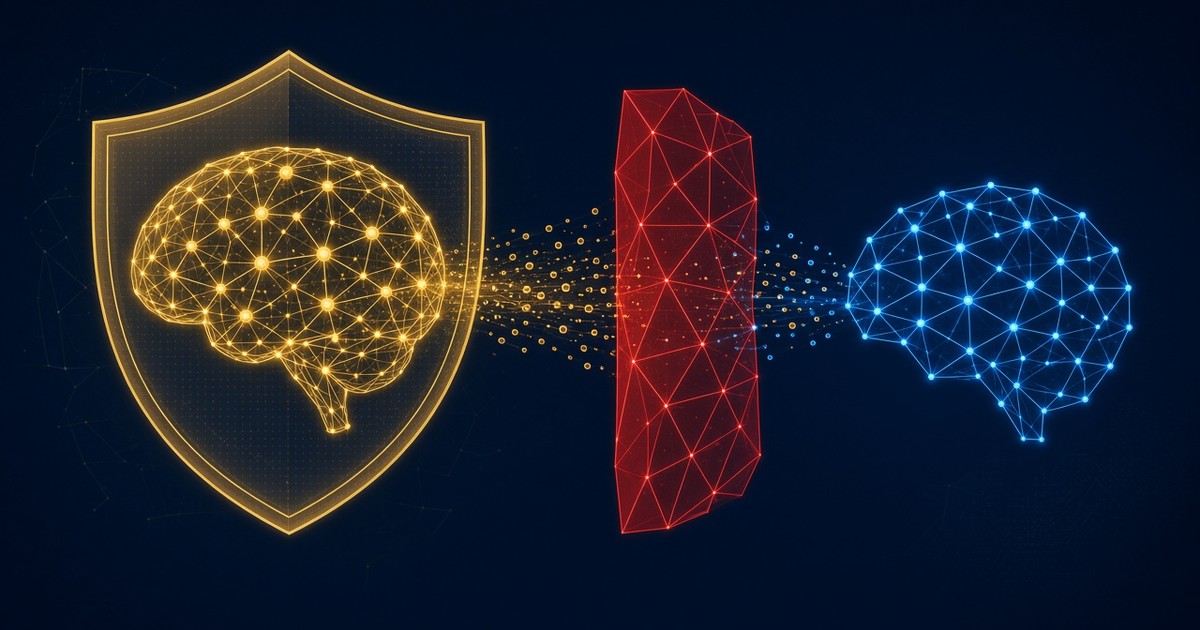
Adversarial distillation is the new name for an old trick: copy a smart model by training a cheaper one on its outputs, then run the copy without the original's safety rules. OpenAI put the term front and centre on November 20, 2026, in a post called "Combatting adversarial distillation", and it has been bouncing around X ever since. My take: the term is useful, the numbers are interesting, and the hard part is not the one most people are arguing about.
What adversarial distillation means
Plain distillation is normal machine learning. A big "teacher" model produces answers, and a smaller "student" model learns from them. Labs do this to their own models all the time to make fast, cheap versions.
The adversarial part is about who does it and what gets left behind. OpenAI defines it as using a frontier model's outputs without permission to train another model with similar skills, then deploying that model "without comparable protections". The teacher might refuse to help write malware. The student learned the skill but never learned the refusal.
A quick example
Say you run a thousand accounts that ask a top model for help with defensive security work. Every request is allowed. You collect the answers, and if you can get them, the model's hidden reasoning steps too. Then you fine-tune your own model on that pile.
Nothing you asked was against the rules, yet your student may now be decent at offensive security. OpenAI tested this with its own teacher and student models. Students trained on the exact reasoning traces generally beat students trained on the short reasoning summaries users normally see, at least after supervised fine-tuning. After a light round of reinforcement learning, the picture got mixed: the exact-trace student won at the largest inference budget, the summary student won at lower ones.
So the prize is the chain-of-thought, which OpenAI calls "protected reasoning".
How OpenAI says it fights back
The defences come in two layers.
- Per request: the model is trained to refuse requests that try to pull out its hidden reasoning, and classifiers check inputs, outputs and even tool-call arguments for leaks. In the API, reasoning is tied to the conversation that made it. Rewrite an earlier message and the reasoning that followed gets dropped.
- Per campaign: OpenAI looks for patterns across accounts, such as mass synthetic-data generation. It says weekly enforcement has ranged from thousands to tens of thousands of accounts.
The headline number: in its own adaptive red-team test, pulling reasoning from an earlier request worked 54.0% of the time against GPT-6 Astra with its old safeguards, and 0.2% against GPT-6.2 Astra with the new ones. For the current request, it fell from 22.9% to 0.9%. The GPT-6.2 system card adds that GPT-6.2 Sol scored 0.5% on the first test, and calls hidden-reasoning extraction "the predominant method of distillation attacks against frontier labs today".
Why I am only half convinced
Those are OpenAI's numbers from OpenAI's test. Both The File and DaySec point out there is no outside audit. The comparison also swaps the model and the safeguards at the same time, so you cannot tell which change did the work.
My bigger doubt is the definition itself. Protecting the hidden reasoning is fine. But the final answers are still visible, and every answer is training data. A patient distiller with enough accounts does not need the chain-of-thought to learn a lot. Defending against this looks less like locking a door and more like making the copying slow and expensive, which OpenAI more or less admits: its stated goal is to raise the cost of campaigns and shorten response time.
There is also an awkward irony people on X were quick to raise. Labs built their models by training on other people's text. Now they want firm rules about who trains on theirs. You can believe both that this is hypocritical and that a copied cyber model with no refusals is a real risk. I do.
A fact worth knowing: a footnote in the OpenAI post points to related Anthropic work that found the same edge for full reasoning transcripts on SWE-bench Verified. So if reasoning traces are this valuable, how long before "show your work" becomes a paid feature rather than a default?