AgenticPPL: Grading AI Agents Without Running Them
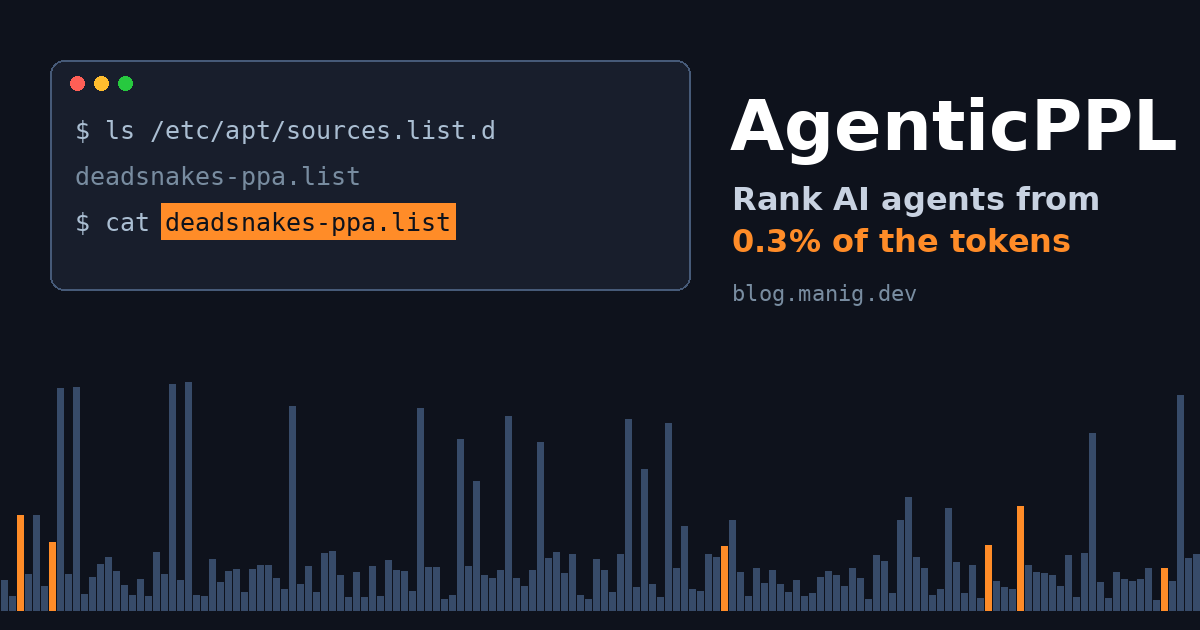
Benchmarking an AI agent is slow and costly. You spin up sandboxes and pay for every token. AgenticPPL, a metric Wenhao Chai published on 25 November 2026, tries to skip all of that. It predicts how well a model will do on Terminal-Bench 2.1 from a single forward pass over fixed agent transcripts. No rollouts, no sandbox, no judge model.
I think it is one of the cleverest eval ideas of the year, and also one to hold at arm's length.
The problem with plain perplexity
Perplexity measures how surprised a model is by text. A 2024 paper, Compression Represents Intelligence Linearly, found a near straight-line link between how well base models compress text and how well they score on benchmarks.
So the obvious shortcut is to score a model's perplexity on recorded agent sessions. Chai tried it. On Terminal-Bench 2.1, plain perplexity ranked 40 open-weight models backwards.
The culprit was terminal output. It holds 35.7% of the bytes but 58.9% of the perplexity, and on its own it ranks models the wrong way round. According to the write-up, weak models get good at predicting terminal text that already showed up earlier, so they look smart on paper. Strong models instead predict their own next move, like starting to think or typing a command. Being good at parroting the screen is not the same as being good at the job. Anyone who has sat through a status meeting knows this.
How AgenticPPL picks the tokens that matter
The fix is to score only a tiny slice of each transcript: about 0.3% of the bytes. These are command tokens the agent writes after reading terminal output.
To find them, a separate evaluator model called Flint reads each transcript twice, once as is and once with every output replaced by [output hidden]. If Flint's surprise on a command token drops by more than 0.5 bits once it can see the output, that token gets picked. Each model's surprise on those tokens is capped at 2 bits and averaged. Higher AgenticPPL means a stronger predicted agent.
A quick example from the post. Say the agent runs ls and the screen prints deadsnakes-ppa.list. In the next turn it types cat deadsnakes-ppa.list. That filename is the kind of token AgenticPPL keeps, because you can only write it well if you actually read the screen.
One confident bet on a different but valid flag can cost 10 to 40 bits and wipe out dozens of small wins. Capping each token lifted the rank correlation from +0.679 to +0.888 on the same picked tokens.
The numbers, and the fine print
On 960 held-out transcripts and 15 open models the search never saw, AgenticPPL ranked models with a Spearman correlation of +0.788 against their real scores. Plain perplexity got −0.495. The code is on GitHub and the data on Hugging Face.
The rule itself was found by two Claude Code agents searching on their own for about two and a half hours. That is a fun twist: agents built the yardstick for agents.
Now the fine print, and to Chai's credit the repo states it plainly. Three searches ran, and +0.788 is the best of the three on the held-out models. The other two scored +0.695 and +0.683. The held-out model names and scores are not released. And it is tuned for one benchmark in one harness. Picture a team swapping its eval suite for this number and then shipping a model that is great at terminal chores but falls over in a browser.
My take: use it as a cheap filter before you pay for full runs, not as a scoreboard. The real lesson is bigger than the metric. Most of what a model sees in an agent transcript tells you nothing about its skill, and the signal hides in the moments where it has to read and react.
Which makes me wonder: if 0.3% of the text carries the signal for terminal agents, what is the tiny slice that would carry it for your own work?
Sources: Wenhao Chai, AgenticPPL: Perplexity (on what?) is intelligence, AgenticPPL on GitHub, AgenticPPL dataset on Hugging Face, Huang et al., Compression Represents Intelligence Linearly.