AI Builder Teams: Throughput Is Cheap, Direction Isn't
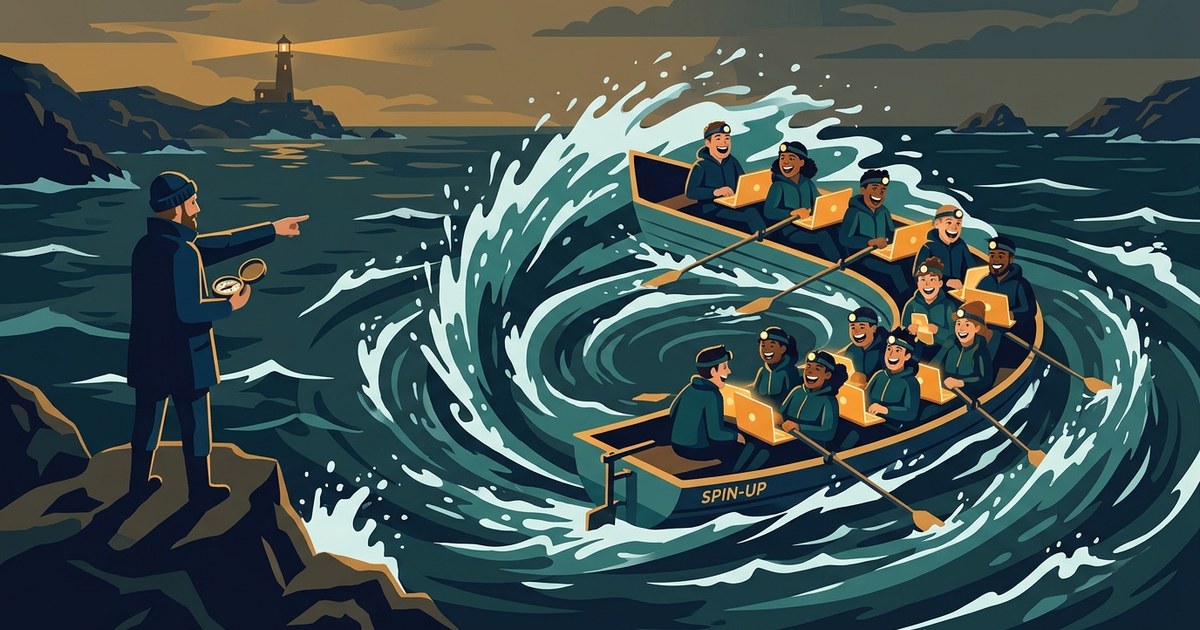
Everyone wants to be an AI builder now. Atlassian took that idea at its word, built whole squads around it, and watched it fall apart in about a month. Not because the AI was slow. Because nobody was steering.
The story comes from Sherif Mansour, Atlassian's head of AI and product craft, on Lenny's Podcast this week. Lenny Rachitsky posted the story on X and the line has been bouncing around ever since: "Throughput's not our problem. Direction's our problem."
What an AI builder is (and what the squads tried)
Mansour's own definition is plain: an AI builder is someone who spends most of their time building software with AI. The hot take a year ago was that this one role would swallow the rest. Why keep a product manager or a designer when everyone can prompt a feature into existence?
So Atlassian tested it. They moved some PMs and designers into a few squads where everyone was an AI builder. No PM. No designer. People came from different crafts, but they all built.
The first few weeks were great. One PM told Mansour it was "unbelievable" and that they had "moved faster than ever before." About a month later the same PM reported that everyone had drifted back to their old jobs. His summary is the quote above, plus this: "I need more people to steer the ship."
Why the AI builder squad stalled
Here is my read. AI made the rowing cheap. It did nothing for the question of where to row.
Picture a team that can ship a feature a day. Great, which feature? For which customer? What do we drop to make room? Those calls used to hide behind slow delivery. When a feature took six weeks, you had six weeks to argue about it. Now you have an afternoon, and the argument is the slowest thing in the building.
Mansour frames the PM job as filling context so the team can decide without waiting on one person. In his words, PMs don't own the decisions, they own "decision making velocity." He also points out that AI "amplifies your strengths and equally it amplifies your weaknesses." Hand a strong engineer a coding agent and you get more good code. Hand a weak product sense the same agent and you get more of the wrong product, faster.
A quick example. Say you run a five-person squad of AI builders with a backlog of 40 tickets. You clear them in two weeks. Week three, the backlog is empty and someone asks, "So what now?" Nobody has talked to a customer in a month. The agents are idle, the humans are in a meeting, and the meeting has no owner. That is the stall.
Where I think this lands
I don't buy the doom take that roles are melting into one. I also don't buy the reverse, that nothing changes. Mansour is careful here too: for a startup or a zero-to-one project, everyone doing everything is fine, and he says he is all in on that. The podcast summary notes his finding is about companies with dozens, hundreds or thousands of engineers, where the hard part is where to point the capacity.
My opinion: the job title matters less than the duty. Someone has to own "what are we doing and why," and that someone has to be in the room with customers. If your AI builder squad has that person, call them whatever you like. If it doesn't, you have built a very fast boat with no rudder.
One small detail I liked. Atlassian also runs "AI builder weeks" where every craft stops and tinkers, and Mansour says the younger folks tend to demo new tools while the seniors drift toward evals and spotting slop. Even the hackathon splits into rowers and steerers.
So here is my question for you: on your team, who decides what the agents work on tomorrow, and could you name them without thinking?