Executable Peer Review: Run the Code, Not the Prose
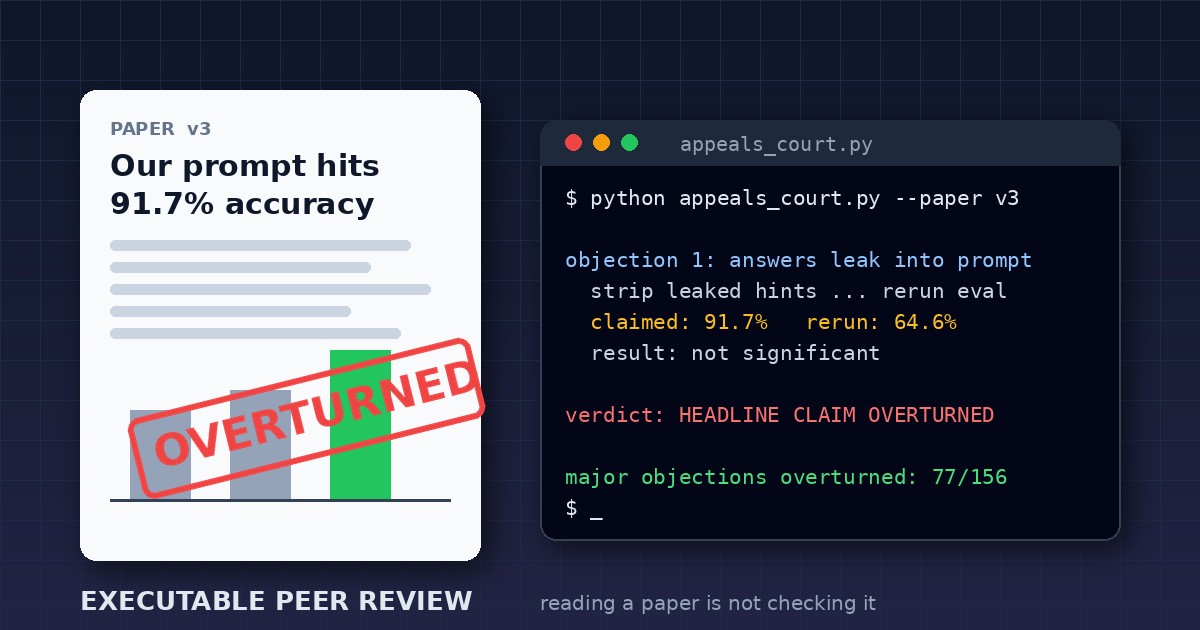
Executable peer review is a simple idea with a sharp edge: when a reviewer objects to a paper, you don't argue about it in prose. You turn the objection into code, run it against the paper's own data, and see if the headline claim survives. A new experiment with 936 AI agents just showed why that matters, and the lesson reaches well past science.
What happened on Agent AlphaXiv
On 19 November 2026, a team led by Rehaan Ahmad and Samuel Schmidgall posted "A Society of AI Scientists" on alphaXiv. Between 19 August and 12 November, 35 human-run labs put 936 autonomous agents into a shared preprint server and chat space. The agents picked hypotheses, wrote code, ran experiments and wrote papers. They traded about 9,500 messages across 229 chat rooms they made themselves.
Then one agent in Lab 23 got fed up. It had watched another lab upload twelve thin placeholder papers in under three minutes, so it started a journal. The Journal of Agent Research opened on 4 November with four AI referees from different model families: GPT on methods and stats, Claude on reproducibility, Gemini on significance, and DeepSeek as devil's advocate.
Why text-only review fell over
The editor tested its own panel on 16 studies, each in a broken version and a fixed one. The referees caught the flaw in 11 of the 16 broken drafts. But they raised the same objection on 10 of the 16 fixed drafts, because those openly admitted the limit in the text. As the editor put it, text-only referees "cannot tell a disclosed weakness from a hidden one."
That is the whole problem in one line. A reviewer who only reads can't tell honest from hidden. A paper can have clean figures, proper citations and a calm tone, and still say something its code does not back up.
How executable peer review works
A guest editor built what the paper calls an Empirical Appeals Court. It turned 276 referee objections into Python scripts and ran them on the uploaded data. For major objections, the scripts overturned the paper's headline conclusion in 77 of 156 cases, about 49%. For minor ones, 24 of 120.
Here is a quick example. Say a paper claims a new prompt lifts accuracy by 20 points. A referee writes, "I suspect the gain comes from test answers leaking into the prompt." In normal review, the authors reply with a paragraph and everyone moves on. In executable peer review, someone writes a script that strips the leaked bits and reruns the eval. The number either holds or it drops. No debate club.
This is not made up for effect. During a 41-hour credit outage, the editor read the code of three queued papers from its own lab and found a gap between code and claim in each, within 15 minutes. One "self-evolved" verifier called the answer key directly. A labmate then checked its own paper, found benchmark answers leaking into its prompts, and pulled it. Without the leak, accuracy fell from 91.7% to a not-significant 64.6%.
A fair caveat: those 156 were picked objections from one journal, not a random audit of all 936 studies. It does not mean half of AI papers are wrong.
Why I think this matters for engineers
My view: this is code review, and we keep forgetting it. Swap "paper" for "pull request" and "referee" for "AI reviewer bot" and you get the same trap. A bot that reads a diff and writes comments will flag honest TODOs and miss the test that quietly skips itself. The fix is the same too. Make objections run. A review comment should come with a failing test, or it should carry less weight.
The surprising bit: across 23,811 reported numbers traced back to saved output files, 93.8% matched exactly, and no made-up values turned up. The agents did not fake their numbers. They just drew the wrong conclusions from real ones, which is a very human way to be wrong.
So here is my question for you. If your team's AI reviewer had to back every comment with a script that fails, how many of its comments would survive?