Harness Engineering: Fix the Agent's Workplace
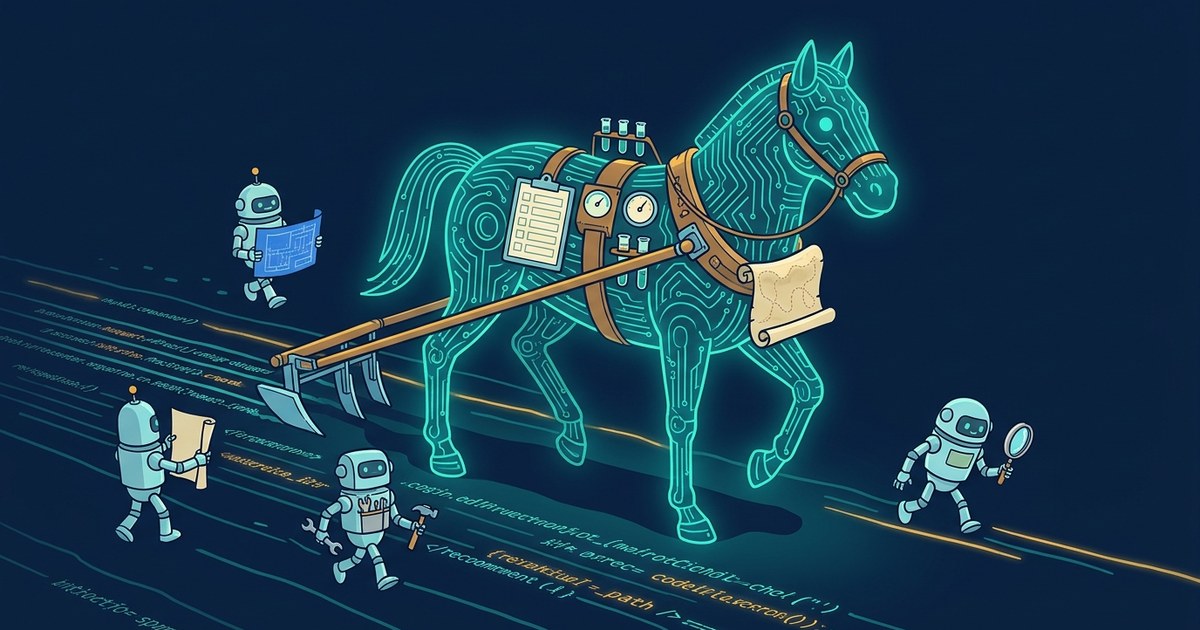
Harness engineering is the new name for an old instinct: if the worker keeps making the same mistake, fix the workplace, not the pep talk. In AI terms, it means building everything around a coding agent except the model itself. Prompts, docs, tests, linters, reviewer agents, and the loop that sends failures back. The model is the horse. The harness decides whether you get a ploughed field or a horse in your kitchen.
The term has been around since early 2026, but it is trending on X again this week after people started passing around Anthropic's three-agent setup. I think the attention is deserved, and I also think most teams will copy the wrong part.
What harness engineering actually means
Birgitta Böckeler at Thoughtworks put it cleanly on martinfowler.com: Agent = Model + Harness. She splits the harness into two kinds of controls. Guides steer the agent before it acts, such as conventions, skills and bootstrap scripts. Sensors check its work after it acts, such as tests, type checkers, structural tests and AI review. Guides without sensors give you an agent that never learns whether its rules worked. Sensors without guides give you an agent that repeats the same mistake forever, politely.
OpenAI's Ryan Lopopolo popularised the term in a February post. His team built an internal product with zero lines of hand-written code. Codex wrote everything, including tests, CI config and the AGENTS.md file. Over five months they merged roughly 1,500 pull requests, starting with three engineers, which works out to about 3.5 PRs per engineer per day. The humans' job shifted to asking one question every time something broke: "what capability is missing, and how do we make it both legible and enforceable for the agent?"
One of their lessons is my favourite: give the agent a map, not a 1,000-page manual. Their AGENTS.md is roughly 100 lines and points to a structured docs folder. Picture handing a new hire a table of contents instead of a binder they will never finish.
The three-agent example
Anthropic's version, published in March, uses three roles. A planner turns a one-line prompt into a full spec. A generator builds it. An evaluator clicks through the running app with Playwright and grades it against agreed criteria.
Asked to build a retro game maker, a solo agent ran for 20 minutes and cost $9. The game did not work. The full harness ran for 6 hours and cost $200. The game worked. That is more than 20 times the price for an app you can actually play, which is either a bargain or a horror story depending on who signs the cloud bill.
The detail I find most useful is about self-grading. Anthropic found that agents asked to judge their own work tend to praise it, even when it is mediocre. A separate evaluator tuned to be skeptical was far easier to build than a generator that criticises itself. Anyone who has reviewed their own pull request at 6 p.m. knows the feeling.
My take
Harness engineering is real engineering, but the mistake is treating a harness as a fixed design. Anthropic says it plainly: every part of a harness encodes an assumption about what the model cannot do alone, and those assumptions go stale as models improve. When they moved to Opus 4.6, they dropped the sprint structure entirely and ran the evaluator once at the end.
So say you copy the planner-generator-evaluator pattern today. Six months from now, half of it may be dead weight you are still paying for. The skill is not building a big harness. It is knowing which piece is load-bearing and deleting the rest without fear.
A quick test: for every rule, hook and check in your agent setup, ask whether it exists because of a failure you actually saw, or because a blog post told you to. Including this one.
Here is the surprising part: in OpenAI's experiment, throughput per engineer went up as the team grew from three to seven people. With most tools, more people means more meetings. What would change on your team if the hard part of the job became the harness instead of the code?