Knowledge Factory: Teach AI Agents How Your Company Works
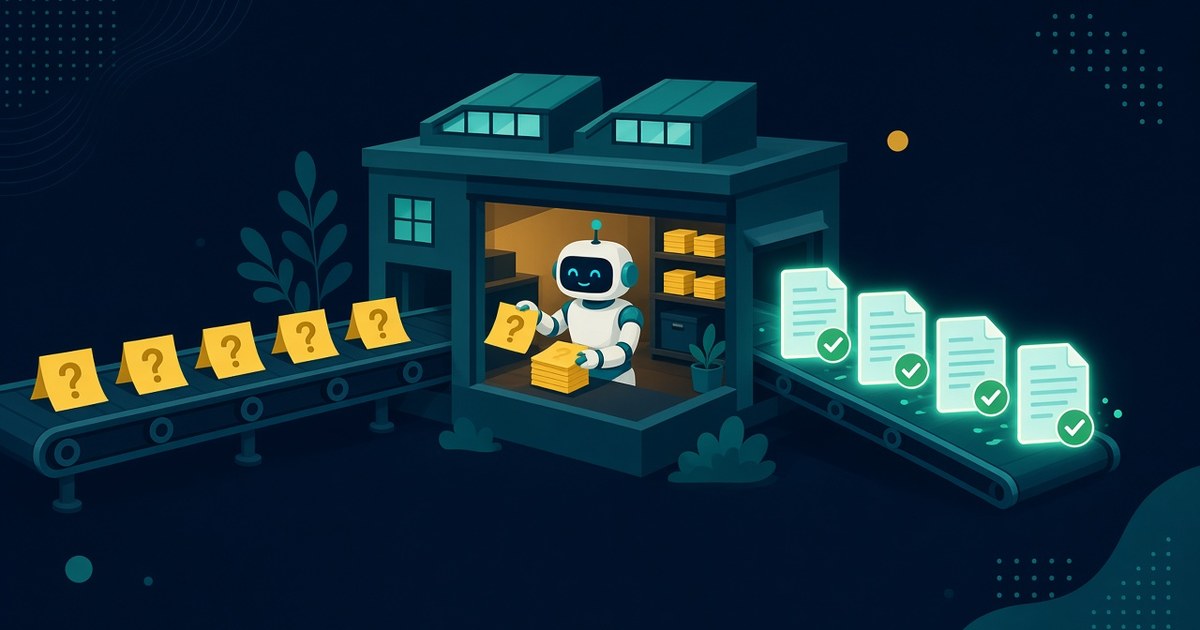
Your best employee knows that "active customer" means something different in finance than in sales. Your AI agent does not. On 21 November, LangChain CEO Harrison Chase gave a name to the fix: a knowledge factory, a system that collects, cleans up and maintains the unwritten rules of a company so agents can use them. He laid it out in How to build a knowledge factory, and it was a trending story on X by the next day.
I think he has put his finger on the real reason most company agents feel dumb. It is rarely the model.
What a knowledge factory is
Chase draws a line between two words people use as if they meant the same thing. Context is whatever the agent has in front of it during a task. Knowledge is the reusable understanding behind it: what a metric means, which source to trust, how the company handles an odd case. Much of it lives only in people's heads.
He sorts that knowledge into three piles:
- Skills. How to do the work the way your company expects. Often passed from coworker to coworker and never written down.
- Domain knowledge. Slow-changing facts about products, customers, competitors and policies.
- Data access guidance. Where current data lives and how to query it. If your warehouse is already the source of truth, you document the path, not a copy.
The name is a nod to "software factories", where your best engineers build the system and agents write the code. Same move, applied to everything that is not code.
The loop that keeps it honest
The factory has three parts. Working agents get a tool to flag missing or wrong knowledge, with an optional suggested fix. A separate curator agent runs on a schedule, reads those flags, reads agent traces, and checks raw sources like Notion and Slack before it updates anything. Then there is storage, which Chase calls both "the least important thing" and "the least explored area". GitHub, Notion, Neo4j or LangSmith Context Hub all work.
Picture the example from the post. An agent builds a revenue report from BigQuery and Salesforce. It notices a column was renamed, works out the right one, and flags it. A finance lead then asks it to use a new header on all documents. That night the curator sees the flag and the chat in the trace, and updates two skills. Tomorrow's report gets both right, and nobody wrote a wiki page.
The smart bit is the split. Chase argues that if every working agent edits shared knowledge, it turns "unruly and full of contradictions". I agree. Say you let fifty interns edit the company handbook whenever they hit a snag. You would get fifty handbooks stapled together.
My doubts
AI Newsway points out that the post gives no performance numbers, and Automater notes it does not say who reviews a change before the curator ships it. That second gap worries me more. An agent that quietly rewrites your company's rules at 2 a.m. needs a pull request and a human, not just good intentions. Store the knowledge somewhere with diffs and review it like code.
Still, the advice at the end is the most sensible part of the post: don't try to document everything first. Start with one recurring workflow, watch where the agent struggles, and close that loop.
Here is the related fact that stuck with me. Stripe's internal agent Kai has over 1,000 skills from more than 100 teams, and Stripe saw frontier models get worse once more than 150 skills were loaded alongside its system prompt. So the job is not only collecting knowledge. It is also throwing the stale stuff out. Who in your company would you trust to approve what the curator agent writes?