MCP Elicitation: When AI Agents Have to Ask First
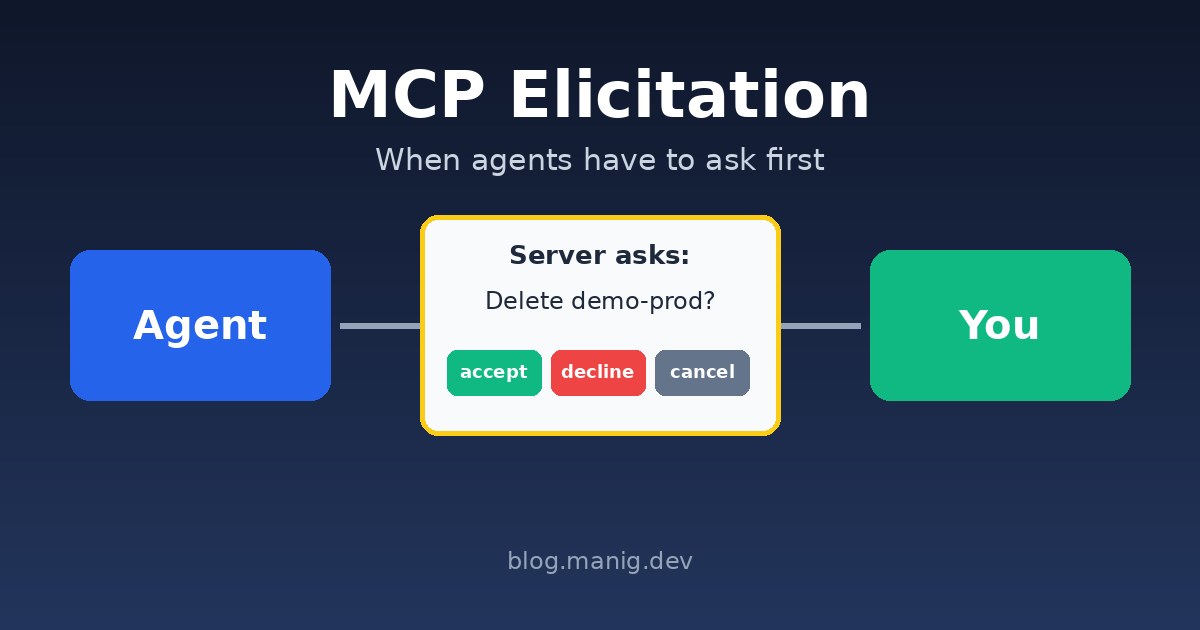
For two years the deal with AI agents has been simple: you ask, they act, and you find out what happened afterwards. MCP elicitation changes the order. It lets a tool server stop in the middle of a job and ask the human a question before it carries on. On November 24, 2026, Anthropic made it generally available in Claude and Claude Code, and I think it is the most boring and most useful thing in that release.
What MCP elicitation actually is
The Model Context Protocol (MCP) is the open standard that connects agents to tools and data. Normally a tool call is one-way. The agent sends a request, the server does the work, the result comes back.
Elicitation adds a pause button. While handling a call, the server sends an elicitation/create request back through the client with a plain message explaining what it needs. The client shows that to you. You answer, and the server picks up where it left off.
The idea is not new. Elicitation landed in the MCP spec in the 2025-06-18 revision. What changed this week is that a big client now supports it for everyone on Pro, Max and Ultra plans, with Team and Enterprise rolling out. A spec feature nobody's client supports is a nice blog post. A feature in a popular client turns into a habit.
Two modes, one rule about secrets
The current spec has two flavours:
- Form mode. The server asks for structured data with a simple JSON schema. Think a text field, a number, a yes/no box. Schemas are limited to flat objects with primitive types, so nobody gets a 40-field tax return in a chat window.
- URL mode. The server sends you to a web page instead. The data you type there never passes through the MCP client.
The rule I like most: servers must not use form mode for passwords, API keys, access tokens or payment details. Those go through URL mode. Clients must show which server is asking, show the target domain before opening a link, and give you clear decline and cancel options.
There are three possible answers, and the difference matters. accept means you approved and sent data. decline means you said no. cancel means you closed the thing without deciding. A good server treats "no" and "I walked away" differently.
A quick example
Anthropic's launch post names three real uses. Supabase confirms the cost before creating a paid project and before running destructive SQL. Railway asks before removing a service. GitHub makes you type a repository's name before an agent deletes it.
Say you ask an agent to clean up old test projects. Without elicitation, the agent decides "old" includes the one your team demos tomorrow, and you learn this from Slack. With it, the server stops and shows a form: "Delete project demo-prod? Type the name to confirm." You type nothing, click decline, and keep your weekend.
Why I think this matters more than it looks
My opinion: most agent safety talk is about the model being smarter. Elicitation puts the check where the risk lives, in the tool that can spend money or delete data. The server knows an action is destructive. The model only guesses. Letting the server say "hold on, ask the human" is a cheaper fix than hoping the model feels nervous at the right moment.
It also beats the current fallback, which is a model asking "Are you sure?" in chat and then accepting "yeah sure" as legal consent.
The catch is fatigue. If every server pops a form for every step, people will click accept the way they click through cookie banners. Server authors need to save it for the actions that cost money or can't be undone.
Here is a fact that surprised me: MCP now sees over 700 million SDK downloads a month, according to Anthropic. That is a lot of tools, and far more of them can now stop and ask in a client people actually use. Which action in your stack would you want an agent to ask about first?