Weak Link Hypothesis: Why AI Code Doesn't Ship Faster
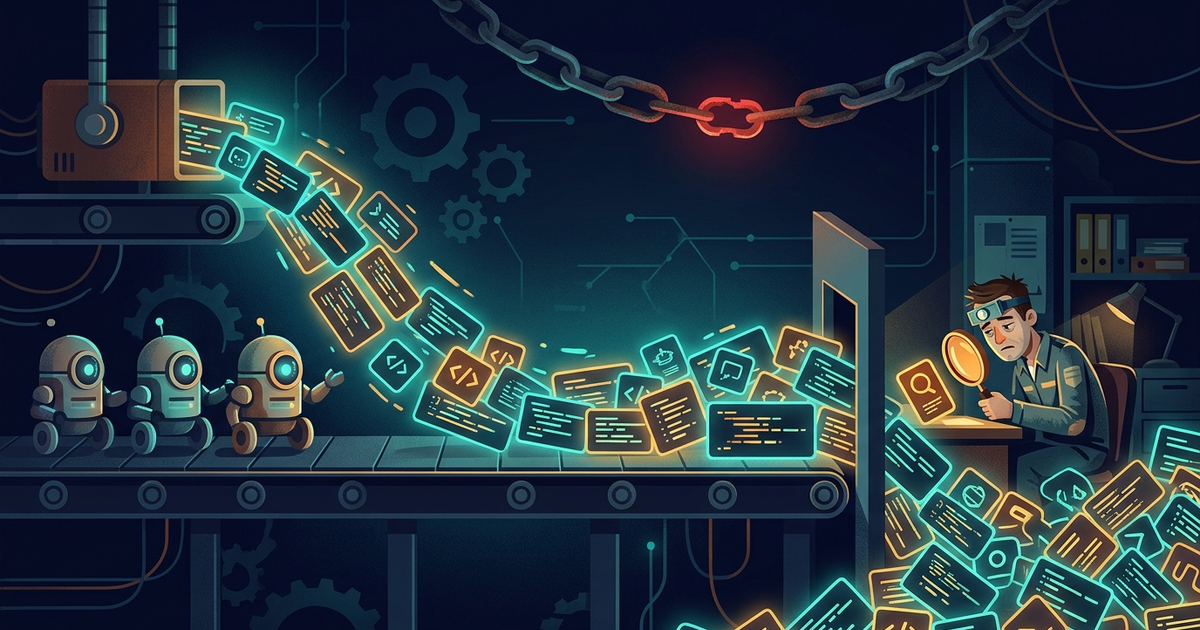
AI coding agents have made writing code cheap. They have not made shipping it cheap. The weak link hypothesis is the cleanest name I have seen for that gap, and it comes from an NBER working paper that X spent the weekend passing around as "writing code vs. shipping code."
The idea is old and simple. A chain is only as strong as its weakest link. Make one step of a process ten times faster and the whole thing still moves at the speed of the slowest step that did not get faster. Economists call this O-ring logic, after Michael Kremer's 1993 paper named for the part that doomed the Challenger shuttle.
What the weak link hypothesis says about AI code
Mert Demirer, Leon Musolff and Liyuan Yang matched more than 500,000 GitHub developers with their AI usage telemetry, then compared each adopter with a similarly active developer from a year earlier. The full paper tracks output layer by layer, from lines of code up to releases.
The numbers at the bottom of the stack are huge:
- Weekly commits rose about 30% with autocomplete, 180% once interactive agents joined, and 240% with autonomous agents on top.
- Interactive ("sync") agents alone raised lines of code by 958% and pull requests by 86%.
The numbers at the top are not:
- That 240% commit boost shrinks to 80% more projects and 30% more releases.
- For sync agents, releases rose just 20%.
Then they checked four app stores: Apple App Store, Google Play, Chrome Web Store and SourceForge. Monthly new apps roughly doubled since early 2025. Total usage of new apps did not rise in any of them.
The authors put the weak link where most of us would guess: code review, quality control and release work, the layers where a human still has to say yes. They estimate an elasticity of substitution of 0.23 between AI output and human effort. In plain words, AI and humans are strong complements here. You cannot swap one for the other, so piling on more of the cheap input barely moves the result.
A quick example
Picture a team of four. Last year they wrote, reviewed and shipped about one feature a week. Now each developer runs agents that open five pull requests a day. Review capacity is the same four tired people. So the queue grows, the branches pile up, and most of the extra work gets rewritten or thrown away. The paper sees exactly this: after adopting sync agents, developers add 7 times as many lines but delete 12.2 times as many, and open 79% more branches.
Same team, same release calendar. Much busier GitHub graph.
My take
I think this is the most useful AI productivity paper of the year, mostly because it kills the commit count as a scoreboard. If your dashboard says output tripled and your customers say nothing changed, the dashboard is measuring the cheap link.
It also says where to spend. Faster code generation is now the easy part. The money is in making review, testing and release faster without making them worse. That means better test suites, smaller diffs, and checks a reviewer can trust at a glance. If you build QA tooling, this paper is basically a job ad.
Two fair caveats. The study covers open-source code and app stores, not much enterprise software. And two of the three authors previously held postdoc positions at Microsoft and now consult for it, as NBER discloses and ShippedByAgents notes. Neither caveat makes the core finding less plausible. Anyone who has watched a review queue already believed it.
One more number to chew on. The share of new repositories that get no activity after their first month rose from 60% in 2021 to 69% in 2026. We are starting more things than ever and finishing about the same.
So where is the weak link on your team: review, tests, or the release button?